Multimedia artist combines macrohistory and microhistory, offering critique of society

Featured on Time Magazine’s 2026 list of 100 influential individuals in the field of artificial intelligence last week, Kim Ayoung is one of the most internationally acclaimed multimedia artists today.
Kim's numerous awards and recognitions include the 2026 Chanel Next Prize, the third LG Guggenheim Award in 2025, the inaugural ACC Future Prize awarded by the National Asian Culture Center in Gwangju in 2024, and the Golden Nica Award’s top prize in the animation art category in 2023.
The list of Kim’s new works and exhibitions around the world hints at a turbo-charged career, especially since the arrival of “Delivery Dancer’s Sphere” (2022). The multimedia work revolves around Ernst Mo, a Dancer who makes deliveries using optimal routes dictated by the Dancemaster, an AI algorithm of the Delivery Dancer app.
In an interview with The Korea Herald in Seoul on July 18, Kim begins her discussion of the Delivery Dancer series with an explanation: “'World-building’ is a term that people like me who create speculative fiction, an imagining of something that does not exist, frequently use. It means to create a non-existing world,” Kim says. "It is great fun to create a world view and build a story, imagining human or non-human protagonists in that world interacting and encountering events."
Her speculative fictions are rooted in reality, she points out. “Rather than a fantasy world, I try to reflect, to the greatest extent possible, problems that I encounter in reality or elements that I find puzzling,” she said.
Self-isolating in her studio in Nakwon Building in downtown Seoul during the COVID-19 pandemic lockdown, Kim used food delivery services two to three times daily, without ever seeing the riders who left the meals at her doorstep.
“I knew they came and went, but there were no traces of them, so I began to think about what invisible labor was. They were essential workers who reigned supreme in Korea during the pandemic, but their work was completely invisible to our eyes. I was drawn to the fact that such important labor was invisible and began interviewing some riders,” Kim recalls.
She also joined a woman rider making her deliveries.
“We rode all over Seoul, and it was a very, very liberating experience. I didn’t have a driver’s license at the time. I had been locked in, unable to leave Korea for three years. It was such an interesting experience to speed through the empty streets of Seoul, cutting through the wind,” Kim says.
The work, however, is anything but liberating. While delivery work was initially promoted as something you could do at your own pace, logging in whenever you wanted to work, the reality is that earnings depend on how fast and how efficiently you can deliver.
“It’s a constant process of negotiations with oneself to optimize,” Kim says. “Every minute, every second is being managed, and I think this is a concept of time that all of us living in the 21st century experience.”
In the Delivery Dancer series, the protagonists Ernst Mo and En Storm are different versions of a person who inhabit different worlds. The premise came naturally to Kim, who has long been interested in the concept of many worlds.
“There are numerous versions of the same person in diverged worlds who should not meet. But the protagonists meet when, for some reason, a hole is created in time or space. Interestingly, the two fall in love,” Kim says. “The logic of this world does not allow it, so their love always ends in a tragic situation in this series,” Kim says.
The series includes a film trilogy — “Delivery Dancer’s Sphere” (2022), “Delivery Dancer’s Arc: 0° Receiver” (2024) and “Delivery Dancer’s Arc: Inverse” (2024) — as well as seven other works derived from the films, including performance, games, installations and sculptures.

The new, site-specific LED panel installation of “Delivery Dancer’s Arc: Inverse” (2024), currently presented as part of “MMCA Gwacheon, 40th Anniversary: Imaginations in Light” at MMCA Gwacheon in Gyeonggi Province, offers another way to view the work.
Installed in front of a glass facade on the third-floor bridge, the fast-moving, bright, and synthetic colors of the LED panels play off against the background of greenery and natural light pouring in through the glass. This setting allows viewers to appreciate the work at a primeval level without prior knowledge of the narrative and the social critique embedded in the Delivery Dancer series.
Even well before working with the speculative fiction form, Kim mixed reality with imagination. “PH Express” (2011-2012), which comprises a 30-minute two-channel video on the British occupation of Geomundo — a group of islands off the southern coast of the Korean Peninsula — and a “fake journal” published in 2012, is one such work.
Watching the video, it is difficult to separate fact from fiction, so seamlessly woven are the two.
"PH Express" was created during a year-long residency at Kunstlerhaus Bethanien in Berlin in 2011. "I had moved to Germany after completing five years of studies in the UK, and I held some bitterness about the remnants of imperialism, racial discrimination and discriminatory policies," she says.
While conducting research in Berlin, she discovered something she had not known before: the British occupation of Geomundo from 1885 to 1887. “It is in textbooks, and everyone knows about it now, but it wasn’t a well-known incident back then,” she says.
The British planned to use Geomundo, which they named Port Hamilton, as a strategic port against the anticipated Russian expansion in East Asia, but withdrew after Russia gave assurances that they would not seize the islands.
Looking deeper into the incident, she determined that she must work with it, not only to restore an untold story but to create a black comedy or dramatize it by mixing tragic and comedic elements.
“It was created as a fiction, but 98 to 99 percent of all dialogues come from archival materials that I found,” Kim says, emphasizing, “It was dramatized, but 98 percent of it is factual.”
Kim points out that the Geomundo incident holds lessons for the present day, observing that the geopolitical situation back then clearly resonates with events taking place around the Korean Peninsula now.
"The work is from 15 years ago, but I think it continues to reverberate today," she says.
AI in art
Kim employs cutting-edge technologies — such as generative AI, immersive VR, game engines, and live action and motion capture — in her works.
“For several years now, I have been introduced as an artist who is fluent with technology. I agree, and I do have continued interest. Because I believe new technologies give birth to new art forms, I rush to research new technologies when they emerge,” she says.
She recognizes that there are concerns about the growth of generative AI and other AI technologies, partly due to their use in conflict situations, Kim says. At the same time, she notes that these technologies are being used to solve difficult problems in medicine, math and industry that humans are unable to solve.
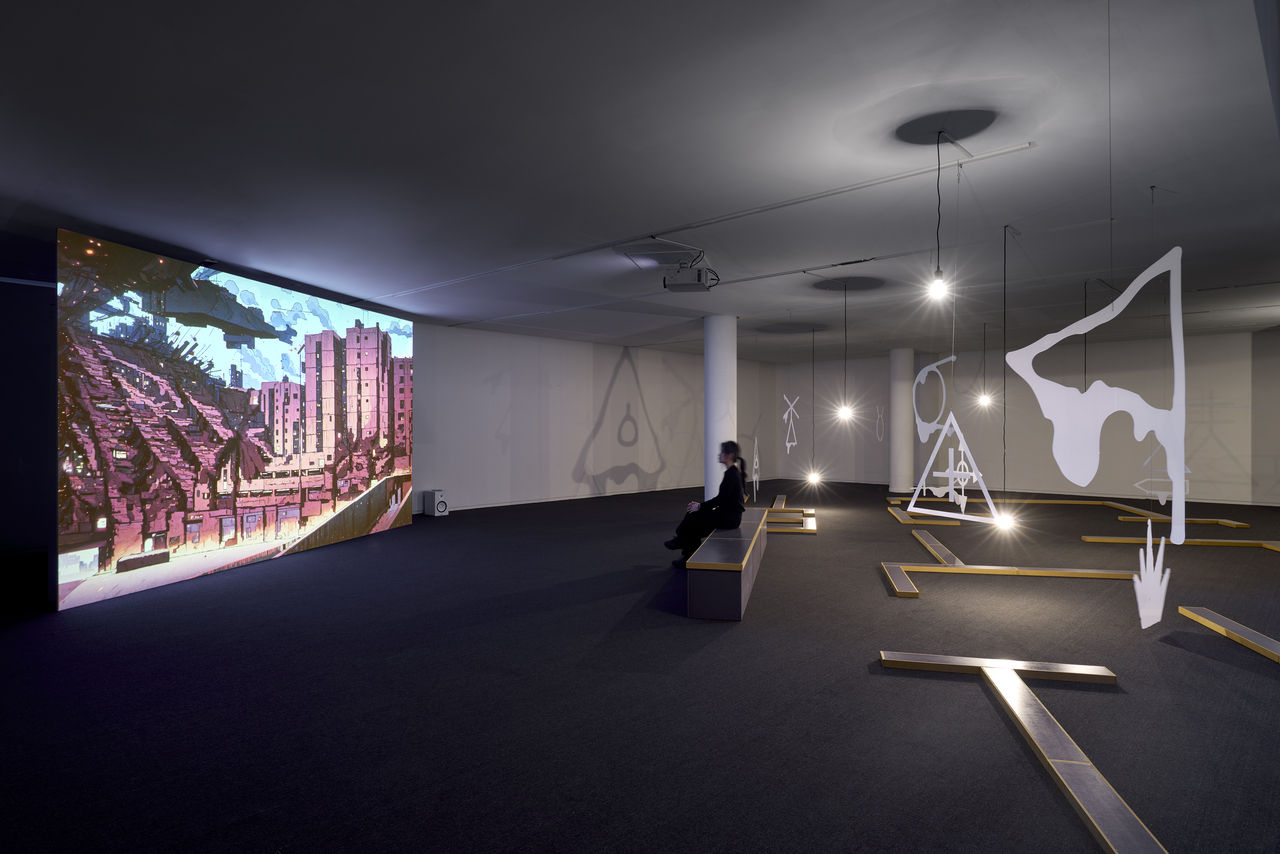
"Last year, I began working on slightly different projects," she says.
“Al-Mather Plot 1991” video and media installations created for her 2025 Atelier Hermes solo show “Plot, Blop, Plop” may be an unfamiliar story for those who know her through the Delivery Dancer series, Kim explains.
The project predates the Delivery Dancer series in its conception, having been on Kim’s mind for 10 years.
In fact, the video work is a continuation of Kim's research into the Middle East and petroleum. Its origins can be traced back to "Zepheth, Whale Oil from the Hanging Gardens to You, Shell," a 6-channel sound installation, wall diagram and live performance that was featured at the 56th Venice Biennale in 2015 to wide acclaim.
"I was doing deep research 10 years ago, and it was only last year that I broached it again, focusing, this time, on an apartment complex built by my father's employer, Hanyang Corporation," she says. Kim's father, a construction engineer, worked in Saudi Arabia and Kuwait for 10 years, returning to Korea at the outbreak of the Gulf War.
"Al-Mather Plot 1991" revolves around the Al-Mather Housing Complex in Riyadh, Saudi Arabia, which was built in 1981 by Hanyang Corporation, weaving together the macrohistory of the Middle East construction boom in the 1980s and the Gulf War with the microhistory of Kim’s father and the Al-Mather complex residents.
"Among the Saudis, it is still called 'Kuwaiti apartment' because Kuwaiti refugees from the war once lived there. Korean expats, on the other hand, call it 'Hanyang apartment," Kim says.
New projects
The past couple of years have gone by at a breakneck pace, with major exhibitions taking place around the world, such as the solo exhibitions “Ayoung Kim: Delivery Dancer Codex” at MoMA PS1 in New York and “Many Worlds Over” at Hamburger Bahnhof – Nationalgalerie der Gegenwart in Berlin.
Now, Kim is getting ready to bid farewell to the Delivery Dancer series with a computer game.
"I think the series will come to an end by the end of the year. It continued, quite unexpectedly, for four years, spawning several spinoffs. I think I've told enough of that story. I think it is time to send the two protagonists off to their world," she says.

Kim is also working on a large-scale project as part of her Middle East research.
The project came about as a series of happenstances.
In 1984, a taxi driver told his passenger that he had become a human host to a species of parasites only found in the Red Sea and the Middle East after eating raw keeled mullet while working in the Red Sea region in the 1980s. The passenger happened to be a world-famous parasitologist, and the chance meeting resulted in a groundbreaking paper.
Ten years ago, Kim, who had heard about the 1984 incident, was in a cab when the driver told her, “You see, I am that guy, actually.”
That chance meeting led Kim to conceive a work that is “fiction, documentary, body horror and, at the same time, biopunk” all rolled into one, which she plans to complete by the year-end. Made with Korean Film Council’s funding for films made using AI, it will be a feature-length film.
Kim, who spent three weeks on a research vessel exploring the South Atlantic at the invitation of the Schmidt Ocean Institute Artist-at-Sea program, is also working on another sizable deep-sea project.
Onboard interviews with researchers and her experience, including joining dives using a remotely operated vehicle, will be used to create an ocean-punk or biopunk project next year.
“That project will be part of a traveling solo exhibition with the first exhibition scheduled to take place in October 2027 at The Bass Museum of Art in Miami. In Korea, the exhibition will open at Art Sonje Center during the 2028 Frieze Seoul period,” she says.
khooran@heraldcorp.com